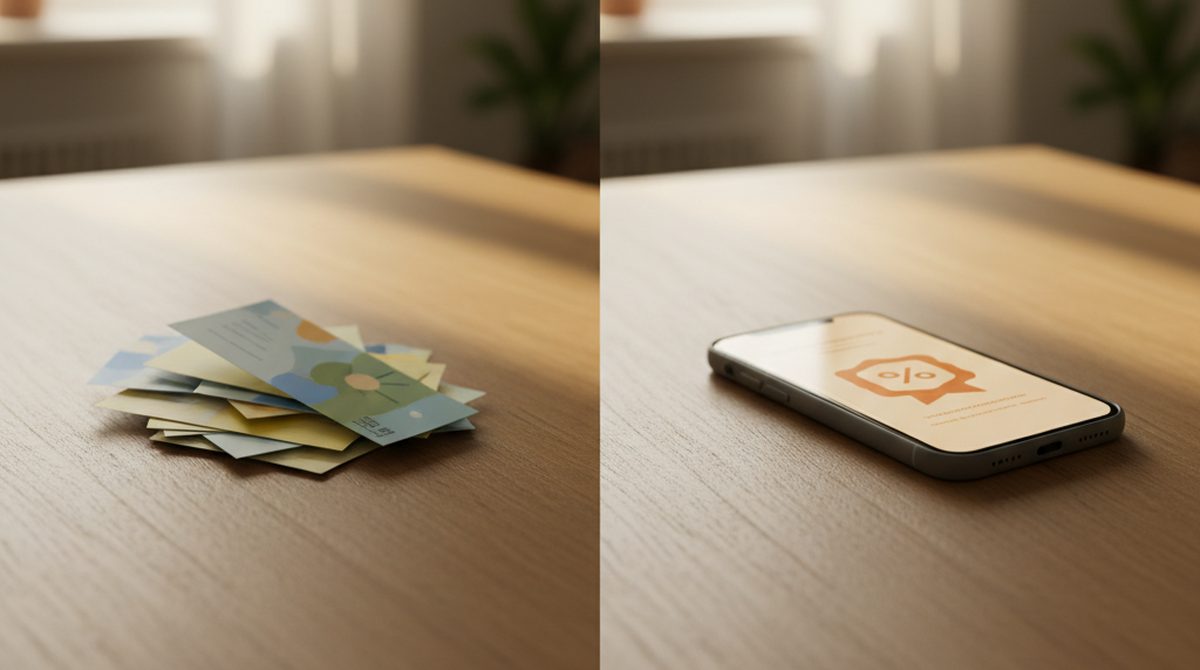
A friend runs a small online shop for handmade ceramics. Last month she ran a coupon campaign: 15 percent off for newsletter subscribers, valid two weeks. Newsletter went out to 4,200 subscribers, sleek HTML mailer with the code in the banner. After the two weeks, she counted: 87 redemptions. About two percent. She was frustrated. "Why do so few people use it?"
The answer is simple. The coupon was in an email. Emails disappear. The code "CERAMIC15" sits in 4,000 inboxes that nobody opens again. In the drawer of the digital inbox.
Why Classic Coupons Have Such Low Redemption Rates
Coupon redemption rates really are surprisingly low. According to Capital One Shopping, only about 1.30 percent of all coupons issued were redeemed in 2024. Direct mail coupons land around 5.22 percent. Digital coupons hit 5.92 percent — clearly better than print, but still far from "most people use them." A truly successful digital campaign reaches 7 percent or more, per industry data.
The reasons are mundane:
Forgotten. The coupon sits in an email or a wallet. A week later nobody thinks of it.
Misplaced. Print coupons from mailings end up in the "I'll get to it" pile. Later never comes.
Wrong moment. You get the coupon at breakfast and don't feel like online shopping. By evening you've forgotten.
Overlooked. Newsletter coupons drown in the inbox flood. Anyone with 50 newsletters in their inbox rarely reads all of them.
Code too long or complicated. If checkout asks you to type "CERAMIC-AUTUMN-2026-15PCT," you give up.
What a Wallet Coupon Changes
A coupon in the wallet lives differently than one in an email. It's:
Visible. Sits in the wallet, not in the inbox flood. Every time the wallet opens, it shows up as a pass.
Location-aware. If the pass carries location data, Apple Wallet can surface the coupon on the lock screen when the customer arrives at the store. Less useful for online shops, a game-changer for local businesses.
Time-relevant. With a relevantDate field, the pass surfaces shortly before expiration. "Valid today" as a gentle nudge.
Updatable. Through the pass update API, the server can push: "Two days left — maybe redeem today?" That's effectively a marketing channel without a spam filter in between.
Directly usable. The coupon sits in the wallet with a QR code. At checkout, just open the pass, show the code — done. No more "where was that code again?"
To set expectations honestly: wallet coupons don't turn 2 percent redemption into 30 percent. But going from 2 percent to 5 or 8 percent — that's realistic, and for many campaigns it's a meaningful lift.
What This Looks Like in Practice
Four steps, concept to distribution:
1. Design the coupon-pass template. Logo, background color, discount as the headline field, expiration date as the expiry field. Most wallet-pass providers offer designer tools. With minimal design, you can click through it yourself.
2. Distribution. Three sensible channels:
- Via email newsletter. Instead of the code in the banner, an "Add to Apple/Google Wallet" button. Recipient taps once, pass lands in the wallet.
- Via QR code in-store, on a window, or on packaging. Customers scan, the pass goes straight into the wallet. Works without newsletter sign-up.
- Via social media link. A story with a swipe-up to the pass download. Recipient adds it directly.
3. Set up tracking. Wallet-pass providers usually offer a dashboard: how many passes were added, how many redeemed, from which campaign (UTM-style tracking parameters at pass-build time).
4. Redemption. In-store: open the pass, have the QR scanned. Online: the pass code is the entry code (or a click-action on the pass opens the shop with the discount already applied).
OtterWallet can build the pass itself — the coupon distribution layer and tracking happen via additional tools or in-house development. But the pass-building work is much lighter than a custom app.
What This Buys a Small Business
Three measurable effects:
Higher redemption rate. Passes in the wallet get redeemed more often than email codes. The exact lift depends on the campaign, but the effect is documented in multiple studies — particularly versus print and pure-email coupons.
Lower print logistics. For campaigns that previously relied on print coupons, the printing falls away. On a mid-sized 5,000-coupon run, that's a few hundred dollars saved.
Better tracking. Which campaign brought how many pass adds, how many redemptions? Nearly impossible with print coupons. Standard with wallet passes.
What Wallet Coupons Don't Replace
Reality check: wallet coupons aren't magic. What they don't do:
Custom app. If you want a full loyalty program with points, tiers, personalization, you need an app. Wallet passes are a channel, not the whole system.
Recipients without wallet usage. Some recipients don't actively use a wallet app. For them, a coupon in the wallet isn't reachable — they still need the email code as a backup.
Very broad mass-distribution campaigns. If you're handing out 50,000 print coupons in a mailer, wallet is hard. Wallet shines with newsletter lists and existing customers.
Bottom Line
Coupons in your wallet aren't a revolution. They're a pragmatic upgrade — more visible, more memorable, more trackable. For small and mid-sized businesses, the setup is cheaper than any custom app and closer to the customer than the next email in the spam filter.
My friend with the ceramics shop is trying it on her next campaign. Coupon as a wallet pass in the newsletter mailer, plus a backup code for the people who don't use a wallet app. We'll see what the redemption rate does. If it lands at 5 percent, the work paid off.