
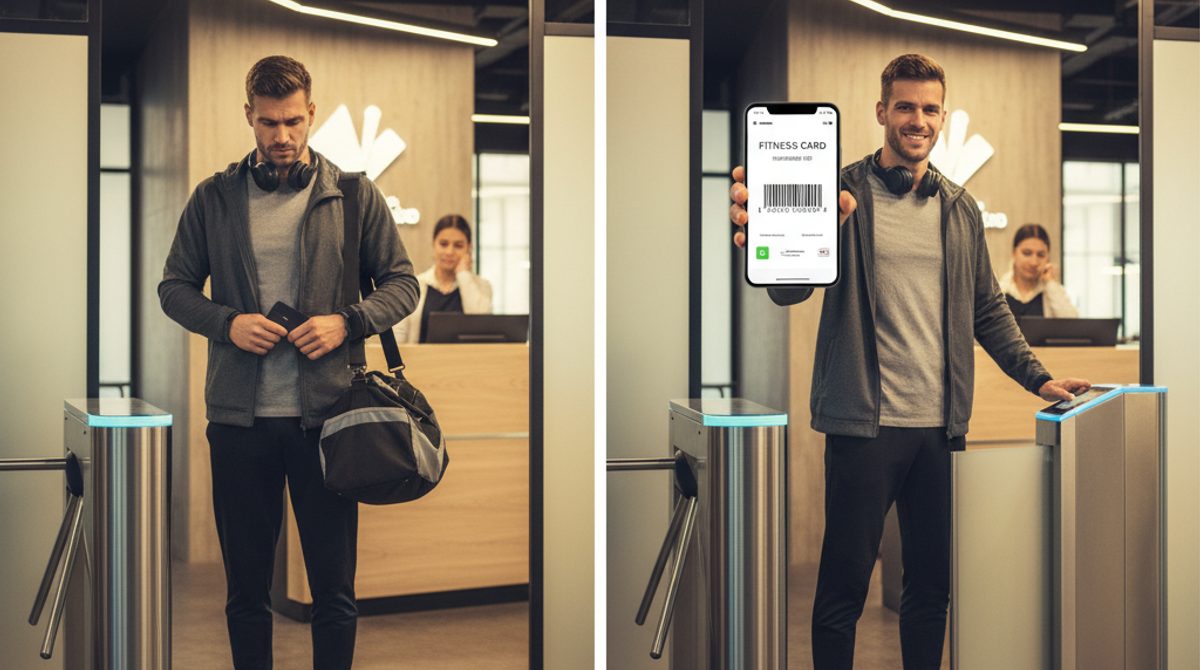
Wednesday evening, half past six. I'm standing in front of the turnstile at my gym. Gym bag over my shoulder, headphones already on, ready to warm up. I tap the scanner. Nothing happens. Of course not — the card is sitting on my desk at home.
This wasn't the first time. Honestly, not even the second. There's this specific moment when you're standing at the turnstile and you realize: I forgot it again. You check your jacket pocket, then the gym bag, then your jeans — as if the card might magically appear if you just look hard enough.
So I walk up to the front desk. "I forgot my card." The woman behind the counter smiles patiently — she's probably heard this three times already today. She types in my name, looks me up in the system, clicks twice, waves me through. Two minutes that feel like ten because three people behind me are waiting with their cards ready.
Millions of Cards in Gym Bags Everywhere
The fitness industry is massive. In Germany alone, 11.71 million people held gym memberships at the end of 2024 — a new record. Globally, the numbers are even more staggering. That's millions of plastic membership cards floating around in wallets, gym bags, and kitchen drawers.
And here's the uncomfortable truth: according to industry analysis, 67 percent of gym memberships go completely unused. Half of all new members quit within the first six months. One reason? Friction. And having to remember a plastic card every single time is just one more barrier between you and actually working out.
The Classic: Card Forgotten, Routine Broken
The problem isn't the card itself. The problem is that it's one more thing you have to remember. Phone, keys, wallet — those are automatic. But your gym card? It's in yesterday's jacket. Or the car. Or the other gym bag.
According to a survey by Pixie, people spend an average of 2.5 days per year looking for lost items. Wallets are among the most commonly misplaced objects — and with them, everything inside. Including your gym card.
Let's be honest: forgetting the card can be enough to skip the workout entirely. Not because the gym won't let you in — most will. But the process becomes awkward, you feel like the person who forgot their ID, and sometimes that's enough to think: I'll just go tomorrow.
Digital Check-In Isn't New — But It's Fragmented
Many large gym chains now offer their own apps for check-in. It works, but comes with a downside: yet another app. A different one for each gym. And when you switch locations or memberships, you start from scratch.
The data shows digital tools make a real difference, though: members who use a fitness app visit three times more frequently than members without one. 72 percent are more likely to stay loyal to a gym that offers digital tools. The threshold needs to be as low as possible — and what's lower than something that's already on your phone?
A Wallet Pass — One Step Instead of an App
A wallet pass works differently than a gym app. It sits right next to your bank card — on iPhone reachable with a double-click of the side button, on Android through the lock screen. No login, no password, no extra app.
The difference in daily life:
Plastic card: Search for card → hope it's there → hold it to the scanner → hope it works.
Wallet pass: Pull out phone → double-click → scan → done.
And the best part: your phone is the one thing you always have with you. It's your alarm clock, music player, and workout timer all at once.
That's exactly what OtterWallet is for. You scan the barcode on your membership card, create a wallet pass in two minutes, and next time you visit, you just hold your phone to the scanner. The plastic card can stay home.
My Routine Now
Since I put my gym card in my phone's wallet, the process is simple:
- Pack gym bag
- Grab phone + headphones (that's it)
- At the gym: double-click, scan, enter
- Start working out
The plastic card has been sitting in my desk drawer ever since. As a backup, in case my phone ever actually dies. Haven't needed it.
What surprised me: it doesn't feel like a big change. It's more like removing a small friction point you didn't even consciously notice before. No searching, no detour to the front desk, no feeling guilty about the line behind you.
Bottom Line
Forgetting your membership card isn't a disaster. But it's a daily annoyance that's easy to avoid. Your phone is always with you — the membership card just needs to get on it once. After that, there's one less step between you and your workout.
Millions of gym members still carry a plastic card around. They don't have to. Two minutes of one-time setup versus zero seconds of searching — every single time.
PS: My gym has since switched to NFC access. The chip hangs as a small tag on my keychain — impossible to forget. And if your gym uses a simple QR code and you have a 3D printer: print yourself a keychain with the QR code on it. Then you won't even need your phone.