
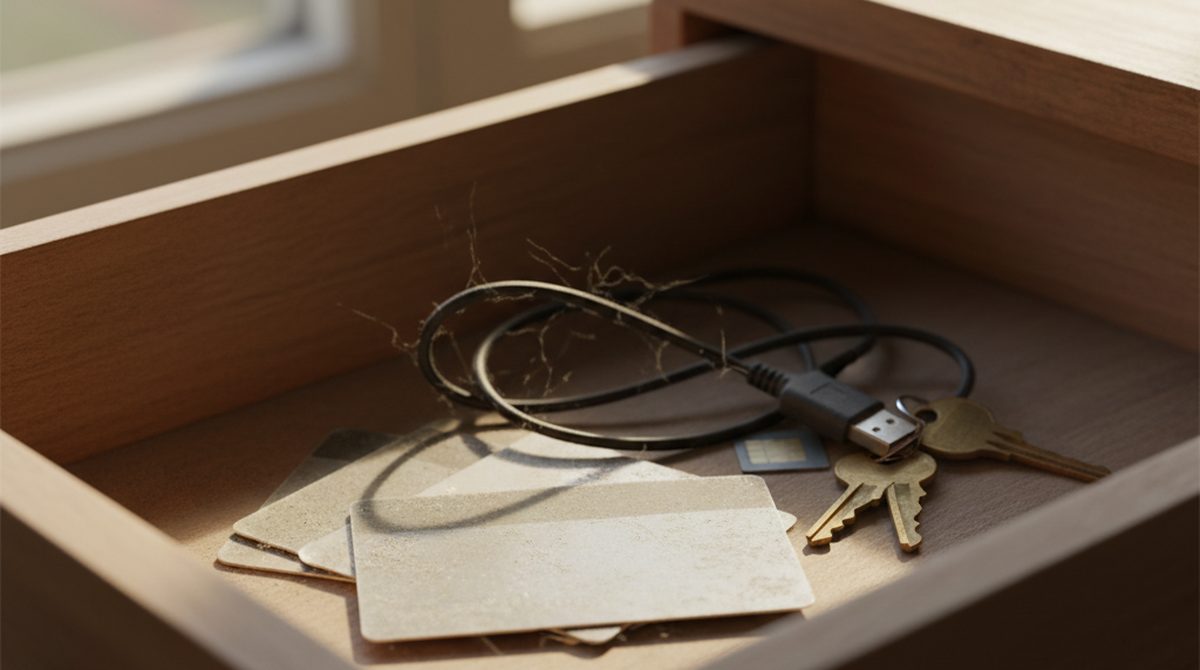
While clearing out a drawer last week I found three gift cards. All forgotten, all unused. One from a bookstore, one from a drugstore chain, one from the Italian place around the corner. They sat at the bottom of a drawer, next to a pile of charging cables, an old SIM card, and a key ring from an apartment I haven't lived in for three years.
Two of them had already expired. The third one — I have no idea how much is on it. Was it the 20-dollar one for a birthday? Or the 50 from grandma at Christmas? No idea. The card shows me a barcode and a long number, that's it. Without the receipt, no balance. Without a balance, no motivation to figure it out.
Why Gift Cards Go Unused So Often
Gift cards are an interesting product. You pay upfront, the retailer gets the cash on the books, and whether the card ever gets redeemed is anyone's guess at that moment. The unredeemed portion has a name in the industry: breakage. And breakage is a meaningful line item — profit without delivering anything in return.
The numbers are striking, especially in the US, where the market is well documented. Industry-typical breakage rates run between 5 and 15 percent, with some sources reporting 10 to 19 percent for certain programs. A recent Bankrate survey found that 43 percent of US adults have at least one unused gift card. Total value: about 23 billion dollars sitting idle.
The reasons are universal:
- Forgotten. The card lands in a drawer and stays there.
- Expired. Without keeping the date in mind, the deadline passes unnoticed.
- No occasion. You have a card for a restaurant you actually like — you just never happen to walk past it.
- Chain gone. Bankruptcies happen. Some brands from the drawer don't exist anymore.
- Balance unknown. You used the card once, forgot what's left on it, and now you don't use it again because the unknown balance is its own friction.
What the Law Says
Gift card expiration rules vary widely by country and even by US state. The federal CARD Act of 2009 requires that most retail gift cards stay valid for at least five years from the date of purchase or last reload. Inactivity fees aren't allowed until after 12 months of non-use, and even then no more than one per month — and the fee terms have to be disclosed before purchase. Some states (California is the strongest example) go further and effectively prohibit expiration on retail gift cards altogether.
Five years sounds like plenty of time. But it feels short when you only see the card once every few months — and shorter still when you don't see it at all because it's been pushed to the back of a drawer.
The Drawer Trap
Plastic cards have a fundamental problem: they are out of sight the moment they're out of your hand. My wallet is small. There's a debit card, a driver's license, and a note with an important phone number. A gift card for a place I visit twice a year doesn't earn its slot.
So the card goes into a drawer. And in the drawer it stops existing for my brain. It only resurfaces when I open the drawer for some completely unrelated reason — and by then it's usually too late.
What Changes When the Card Lives in Your Wallet
A wallet pass works differently from a plastic card. It's always with you because your phone is always with you. It surfaces on your lock screen when you walk past the store — if you turn that on in the pass settings. And it has an expiration date that Apple Wallet and Google Wallet flag a few weeks ahead of time.
That's the real shift. A gift card is a stored value. If the value isn't visible, it effectively isn't there. In your wallet it's visible, regularly, without you having to actively look for it.
Bonus: you can keep the remaining balance as a note on the wallet pass. The pass doesn't pull a live balance from the retailer's system — most gift cards don't expose that. But you can update it manually after each use: "23 dollars left, as of May 12." Still better than a card with "something on it" sitting in a drawer.
How to Get a Card Into Your Wallet
Three paths, depending on what you have:
- Card with a barcode or QR. Take a photo or scan it directly. The result: a wallet pass with the same code.
- Card with just a number printed on it. Type the number in or photograph it, then generate a wallet pass with Code 128 or QR. Works at the register the same way — the cashier system just needs the number.
- Digital gift card from email/PDF. Pull the code out of the email and save it as a wallet pass. Saves the digging through old inboxes later.
OtterWallet is built for exactly this: enter the code or upload a barcode photo, set the title and description, add the expiration date — done. Both Apple Wallet and Google Wallet are supported. No retailer app required.
Tip: Send a Gift Card as a Wallet Pass
When you're the one giving a gift card, you can skip the plastic. Send the code as a wallet pass — by email, by messenger, whatever. The recipient saves it straight into their wallet, has it on them from then on, and doesn't lose it in a drawer.
This works especially well for last-minute gifts. It's December 23rd, the stores are closing, you have nothing wrapped — no problem. Code in, wallet pass out, two minutes. Send it via messenger, the recipient has the gift in a second.
Bottom Line
Gift cards are stored value. If that value isn't visible, it effectively isn't there — which is exactly what happens in a drawer. In your wallet it's visible again: with expiration warnings, location reminders, and all the other advantages digital cards have over plastic ones. Five years sounds like plenty until you realize two of my three cards never even made it that far.
The next one I receive goes straight into my wallet. The next one I give doesn't get a plastic card in the first place — OtterWallet does that in two minutes.