
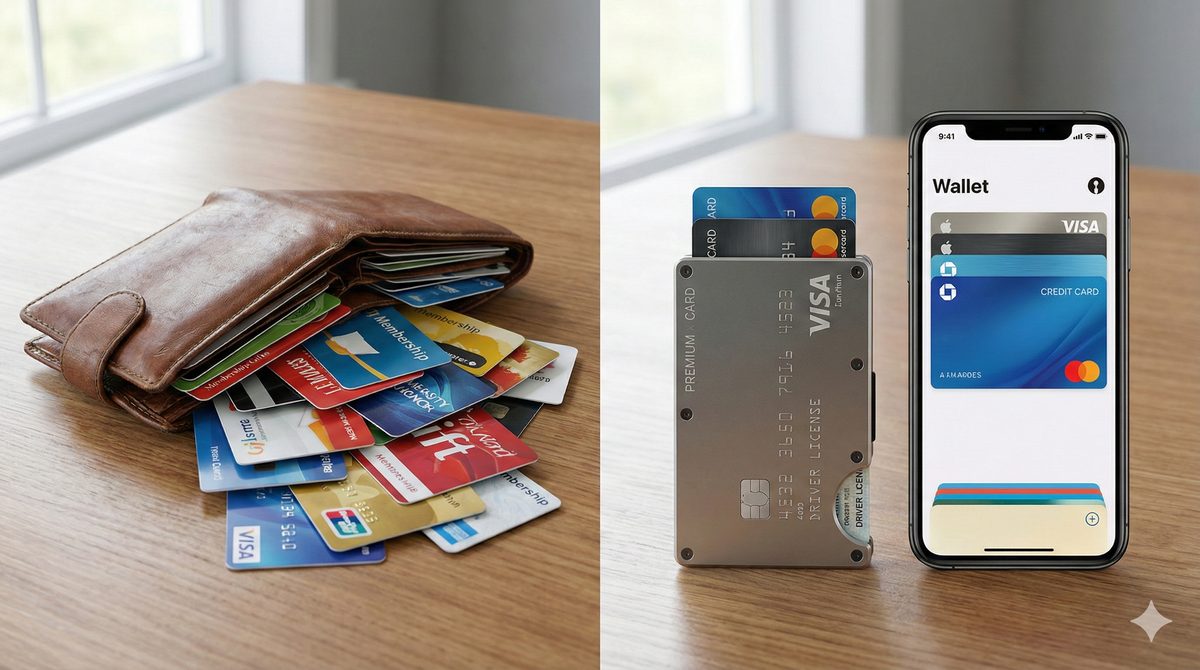
My wallet was a brick. Not an exaggeration — it wouldn't fold shut properly anymore. Two bank cards, driver's license, ID, health insurance card, and then: fourteen plastic cards. Loyalty cards, membership IDs, library card, gym card, club membership. Some of them I hadn't used in years, but there they were.
In January, I decided to get rid of all of them. Not cancel the memberships — just the plastic cards. Everything with a barcode should go on my phone. One month, one card at a time.
This is what happened.
The Inventory: 14 Cards, 14 Problems
Before starting, I laid out all the cards on the table. The result was sobering:
- 6 loyalty cards (grocery, drugstore, hardware store, bookshop, electronics store, pet shop)
- 3 membership IDs (sports club, roadside assistance, library)
- 2 rewards cards (gas station, bakery stamp card)
- 2 gift cards (presents I'd forgotten to redeem)
- 1 access card (gym)
On three cards, the barcode was so worn I doubt it would have scanned. For two of them, I'd forgotten what they were even for.
According to the Bond Loyalty Report, this is pretty normal. The average consumer is enrolled in 19 loyalty programs but actively uses barely half of them. The rest just sits in the wallet, taking up space.
Week 1: The Easy Ones
The first six cards were straightforward. Scan the barcode with my phone camera, format detected automatically, create wallet pass, done. The grocery store, drugstore, and hardware store cards all worked on the first try. The next day, I tested the digital cards at checkout — all three scanned immediately.
The bookshop and pet store cards had Code 128 barcodes — no problem either. The electronics store card was a QR code, which works best on a screen anyway.
Six cards gone, eight to go.
What surprised me: how much thinner the wallet already felt after one week. Six plastic cards sounds like nothing, but the difference is noticeable.
Week 2: The Edge Cases
Now it got more interesting.
The bakery stamp card: No barcode. Just ten fields to get stamped. Can't be digitized — there's no code to scan. Result: that one stays in the wallet. I'd only lose it in a jacket pocket.
The roadside assistance card: Has a barcode, but the service also identifies members through a number in their app. I still loaded the barcode into my wallet — just in case the app isn't installed or won't load.
The library card: Code 39, an older format. Works on both Apple Wallet (as Code 128) and Google Wallet (natively as Code 39). Scanned perfectly at the checkout desk.
The gym: This one was tricky. The access card has an NFC chip — the door opens contactlessly. You can't transfer the chip to a wallet. But on the back of the card was a barcode that staff scan at the front desk. I digitized that. I still use the plastic card for the door, but now it lives in my gym bag instead of my wallet.
Three more cards out of the wallet (plus the stamp card, which stays). Five to go.
Week 3: The Forgotten Gift Cards
The two gift cards were a chapter of their own. One was a Christmas present from last year — 25 euros for a bookshop. The other a birthday gift card for a restaurant — 50 euros.
For the bookshop, I scanned the barcode and loaded it into my wallet. On my next visit, the cashier scanned the code — remaining balance still there. Simple.
The restaurant card had no barcode — just a code to read out loud. I created a generic pass with the code as a text field. Obviously won't scan, but at least I won't forget the gift card anymore.
This is actually a widespread problem: in the U.S., gift cards worth $21 billion go unredeemed every year. Nearly half of all adults have at least one unused gift card lying around — worth an average of $187.
Week 4: The Result
After one month: 13 out of 14 plastic cards removed from my wallet. 11 of them as digital wallet passes on my phone. The gym's NFC access card now lives in my gym bag. One card — for the electronics store I haven't visited in over a year — I simply tossed. And the bakery stamp card? That's the one plastic card that stays. No barcode, no alternative.
My wallet now contains: two bank cards, ID, driver's license, health insurance card, and a single stamp card. That's it. It folds shut again. It fits in my pocket without leaving a bulge.
What I Learned Along the Way
Scanning beats typing. Early on, I tried manually entering a card number. I accidentally chose the wrong format (QR instead of EAN-13). At checkout: error. Since then, I always scan with the camera — the format is detected automatically.
Test before you toss. I tested every digital card at least once in the store before throwing away the plastic. In one case (gas station rewards card), I had to correct the barcode format. Had I already tossed the plastic card, that would have been painful.
Not every card can go digital. The bakery stamp card has no barcode. The gym card needs its NFC chip. Some cards simply can't be digitized — and that's fine.
The effect is bigger than expected. It's not just about space. It's about not frantically flipping through 14 cards at checkout, but just pulling out your phone. Faster, cleaner, less stressful.
And the Environment?
Something I hadn't considered before: over 40 billion plastic cards are produced worldwide every year. PVC cards take up to 500 years to decompose. Only 9 percent of PVC has been recycled in the past 15 years.
Sure, my 14 cards won't save the planet. But if millions of people do the same, it adds up. In the UK alone, 76 million plastic cards ended up in landfills over five years — 380 tonnes of plastic.
Bottom Line
Removing fourteen cards from my wallet took about two hours total — spread over a month, one card at a time. The effort per card: two to three minutes. The payoff: a wallet that's a wallet again, not a filing cabinet.
The trend is clear. In Germany, the cash share of transactions has dropped from 58 to 51 percent — in just two years. Mobile payments have tripled. And the market for minimalist wallets is growing at over 7 percent annually. People want to carry less. The smartphone is taking over.
If you want to try the same experiment: OtterWallet requires no download, no registration, and no subscription. Scan the barcode, create a wallet pass, toss the plastic. My tip: start with the card you use most often. The rest follows naturally.